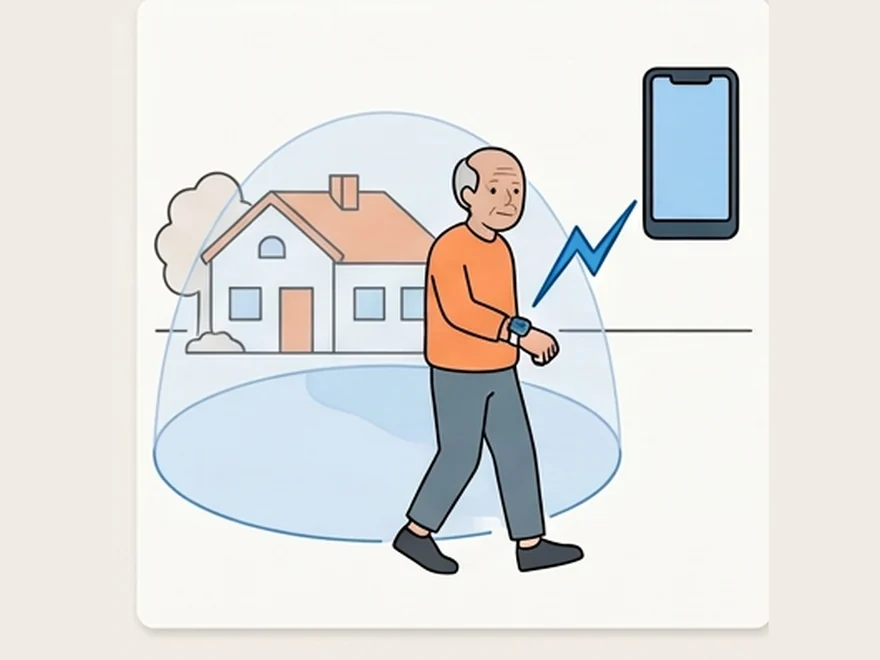
The three that decide it
Will they keep it on? Who answers when the alert fires? Does it work without a phone? Almost every device that ends up unused fails one of these. Features are easy; these three are not.
Read next · Cellular or tethered? The difference only shows up on the worst day — why geofence alerts stop working the moment the phone is left behind.
What the evidence says about wandering
The short version: around six in ten people living with dementia will wander at least once, often repeatedly — and those who do are typically found close to home. That second fact should shape what you buy.
Why "found close to home" changes the device you need
The Alzheimer's Association reports that six in ten people living with dementia will wander at least once, and that people with Alzheimer's who wander are typically found within about a mile and a half of home.
"Critical wandering" has a specific meaning: leaving a location while unaware of place or time. It isn't aimless walking, and it isn't confined to people who seem obviously disoriented.
The practical implication runs against how these devices are marketed. If the person is usually found within a small radius, the thing that matters is knowing quickly that they've left — not tracking them across a county. A device that alerts within a minute of the front door opening does more good than one with superb long-range accuracy that nobody checks for an hour.
Which is why the next section matters more than any spec.
Home-exit alerts usually beat geofences
The short version: a tight geofence around a house will fire constantly from GPS drift, and families mute what cries wolf. A door or exit sensor answers the real question — have they left? — without the false alarms.
Why geofences misbehave, and what to use instead
GPS is accurate to roughly 3–10 meters outdoors in good conditions, and considerably worse near buildings, where signals bounce. Indoors it often fails entirely, and the device falls back to Wi-Fi positioning or cell tower ID — accurate to a room at best, a kilometer at worst.
Draw a 50-meter circle around a house and feed it a position that wanders by tens of meters while the person sits in an armchair, and the result is predictable: repeated alerts that mean nothing. Within a fortnight the family stops looking.
Alternatives that behave better:
- Door or exit sensors — a contact sensor on the front door answers exactly the question that matters, with no GPS involved.
- Larger, softer boundaries — a wider radius with a delay before alerting removes most drift alarms while still catching a genuine departure.
- Time-aware rules — leaving at 3am is a different event from leaving at 3pm, and good systems let you say so.
A useful question for any seller: "what stops this alerting when nobody has moved?" A vague answer tells you the family will end up muting it.
Bluetooth devices are the wrong tool here
A Bluetooth tracker reports position only when it's near a paired phone, or when a stranger's phone passes close enough to relay it. Someone with dementia who leaves the house is, almost by definition, not carrying their phone — and may be somewhere with nobody around. This is the single most common mismatch in this segment, and it's sold every day. For live tracking you need a device with its own cellular connection.
The question sellers avoid: will they wear it?
The short version: a device that comes off is worth nothing, and this is where most purchases fail. Tamper resistance helps a little. Choosing something that doesn't feel like surveillance helps more.
What tends to stay on, and what doesn't
- Familiar objects survive best. Something resembling a watch they've worn for decades is accepted more readily than an obvious medical device.
- Shoe insoles and clip-on trackers sidestep the wrist entirely, and work well for people who remove jewelry. They rely on the right shoes being worn.
- Tamper-resistant straps require a tool to remove. They genuinely help — and they raise a question worth sitting with, because a device someone can't take off is closer to a restraint than a reminder.
- Charging is the quiet failure. A device needing nightly charging depends on someone remembering, every night. Multi-day battery isn't a luxury in this segment.
Consent, capacity and the thing worth thinking about
The short version: the need for monitoring rises exactly as the ability to consent to it falls. That tension can't be engineered away, but the research is clear that involving the person early, while they can still take part, matters more than any later safeguard.
What the ethics research recommends
Reviews of the ethics literature on electronic tracking in dementia care converge on a few points:
- The timing problem is structural. As dementia progresses the need for monitoring increases while capacity to consent decreases. Waiting until tracking is clearly needed usually means waiting until the person can no longer meaningfully agree to it.
- Decide early, together. While capacity remains, a written agreement involving the person, their family and health professionals is the recommended approach — recorded while they can still say what they'd want.
- Nobody should be coerced. The consistent recommendation is that the person's preferences and best interests stay central, and that they're involved in the decision rather than informed of it.
- Care settings struggle with this in practice. Research into care homes found staff often lacked awareness of the ethical implications and were unsure whether to respect a resident's refusal or defer to family consent — an unresolved conflict between autonomy and duty of care that falls on people with no training in it.
If you're making this decision for a parent: the most useful thing you can do is ask them now, while the question is still hypothetical. "If you ever got lost, would you want me to be able to find you?" Most people say yes — and having asked changes what you're doing later.
Carrier-certified, or open market?
Dementia trackers are sold heavily on marketplaces, often by brands that appear and vanish. A device sold through a mobile operator has passed PTCRB certification and that operator's own testing and data requirements. One bought on a marketplace has usually cleared only FCC radio authorization — nothing about encryption, retention, or who holds continuous location data on a vulnerable adult. How to check →
Nine questions before buying
- Does it work without a phone nearby? (If no, stop here.)
- How long does the battery last in real use, and who charges it?
- Who receives the alert — and who answers at 3am?
- Can two or more family members, or a care agency, be added?
- What stops it alerting when nobody has moved?
- Can a home-exit alert be used instead of, or alongside, a geofence?
- Can they remove it, and what happens when they do?
- Have we asked them what they want, while they can still tell us?
- Who holds the location history, where, and for how long?
What we're working on
Assessments for this segment will cover battery under continuous tracking, alert latency from door to phone, tamper resistance, multi-carer access, monitoring-center response, certification status and published SAR figures. The weekly brief is where they land first.
Not medical advice, and no prevention claims. No device prevents wandering, and none replaces supervision or care. A device may shorten the time before someone is found. That is a real benefit, and it is a different claim. Decisions about monitoring a person with dementia should involve them wherever possible, and are best discussed with their clinician and, where relevant, legal advice on capacity.