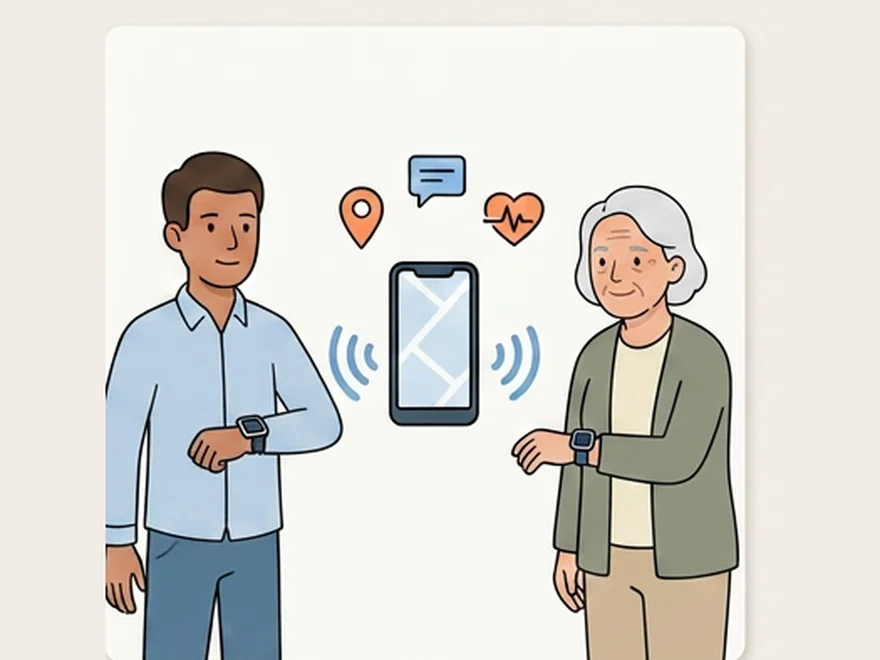
Start with the need, not the age
A fit 78-year-old walker and a frail 62-year-old after a stroke need almost opposite devices. Work out which of these describes the situation: everyday health tracking, a specific heart concern, reassurance while out alone, or help after a fall. Each points somewhere different, and only the last is really the medical-alert category.
Read next · Cellular or tethered? The difference only shows up on the worst day — why a watch that borrows a phone’s connection may not be able to call for help.
Four needs, four different answers
| The need | What suits it | What people buy by mistake |
|---|---|---|
| General fitness & sleep | Any mainstream smartwatch or band | A medical alert they don't yet need |
| Heart rhythm concern | A watch with ECG, used alongside a clinician | Assuming it replaces a diagnosis |
| Out alone, wants reassurance | Cellular watch or mobile alert with SOS | A Bluetooth device needing a phone they don't carry |
| Falls, or fear of falling | Monitored alert with fall detection — pendant or wrist | A fitness watch, on the assumption fall detection is equivalent |
Fall detection: useful, and less reliable than people assume
The short version: fall detection catches many falls but not all, and misses the slow slide to the floor most often. Treat it as a backstop behind a button the person can press — never as the reason to skip one.
What the studies actually found
Published figures vary because the tests do. A smartwatch app study reported 77% sensitivity with 99% specificity — meaning roughly one fall in four went undetected, though false alarms were rare. A 2024 analysis of wrist-worn detection put sensitivity at 81.9%.
Two findings matter more than the headline numbers:
- Which wrist matters. Falls were more likely to be detected when the person fell on the same side as the watch.
- It does not generalize. A University of Illinois study of Apple Watch fall detection among wheelchair users found sensitivity of just 4.7% — a 95.3% false-negative rate. Algorithms trained on ambulatory falls do not transfer to different bodies and different movement.
In the other direction, real-world deployments generate many false alarms: in one four-month trial of a commercial system with 18 participants, 83 of 84 alerts were false. That matters because families mute what cries wolf.
Placement is the other lever. Chest-worn sensors have been measured around 98% accurate, and reviews find trunk, foot or leg placement outperforms the wrist. A pendant is less appealing than a watch and detects better — a genuine trade-off, not a marketing choice.
ECG and heart rhythm: what clearance does and doesn't mean
The short version: a consumer ECG can flag a possible problem worth showing a doctor. It cannot diagnose one, and it says nothing about heart attacks.
The detail on clearance, accuracy and limits
Apple Watch's ECG received FDA clearance in 2018, and the later AFib History feature was cleared for people aged 22 and over who already have a diagnosis of atrial fibrillation — a narrower permission than most coverage implies.
On accuracy, one multicenter study in people with known AF found 100% specificity but 72% sensitivity: when it says something is wrong it is very likely right, but it misses a meaningful share of episodes. Reassurance from a normal reading is therefore weaker than the alarm from an abnormal one.
Documented limits worth knowing before relying on it:
- It returns inconclusive below 50 bpm or above 120 bpm — exactly when someone may be most worried.
- It is evaluated only for detecting AFib or confirming normal sinus rhythm. It cannot detect a heart attack and does not identify other arrhythmias.
- Tremor — from Parkinson's, for instance — can prevent a clean signal.
- Most validation has been done in younger populations, while AF risk exceeds 20% by age 80. Performance in the oldest users is less well established.
If chest pain is involved, this is not the tool. That's an emergency call, not a watch reading.
Carrier-certified, or open market?
Medical alert devices are sold both ways. One sold through a mobile operator has passed PTCRB certification and that operator's own testing and data requirements. One bought on a marketplace has usually cleared only FCC radio authorization — which says nothing about encryption, data retention or who holds the data. For a device someone's safety depends on, the difference is worth two minutes. How to check →
"Monitored" is doing a lot of work
The short version: ask who answers when the button is pressed. A monitoring center and an app notification are sold with similar words and behave nothing alike.
The three models, and who they suit
- Professional monitoring center. A trained operator answers day or night, talks to the person, and escalates to emergency services or a named contact. Monthly fee. Works when family are asleep, working or far away.
- Family app alerts only. The device notifies contacts through an app. No fee, and no answer at all if nobody's phone is to hand. Fine as a supplement; risky as the whole plan.
- Direct-to-emergency-services. The device dials the emergency number itself. No monthly cost, but no context is passed on and nobody can confirm whether it's real.
Whichever it is, the questions to ask are the same: who answers, how quickly, what happens if there's no reply, and who is contacted second.
Questions before buying
- Does it need a phone nearby — and will that phone actually be carried?
- Who answers when the button is pressed, and at 3am?
- Can more than one family member receive alerts?
- How long does the battery last in daily use, and who charges it?
- Will they wear it? A device in a drawer detects nothing.
- Is fall detection the backstop, or the plan? It should be the backstop.
- What happens to the location and health data — who holds it, for how long?
What we're working on
Assessments for this segment will cover real-world battery, app quality, monitoring-center response, certification status and published SAR figures. The weekly brief is where they land first.
Not medical advice, and no prevention claims. Nothing here diagnoses or treats any condition, and no wearable prevents a fall or a cardiac event. A device may shorten the time before someone gets help, and a consumer ECG may prompt a conversation with a clinician. Both are real benefits, and both are different claims. Always consult a qualified healthcare professional.