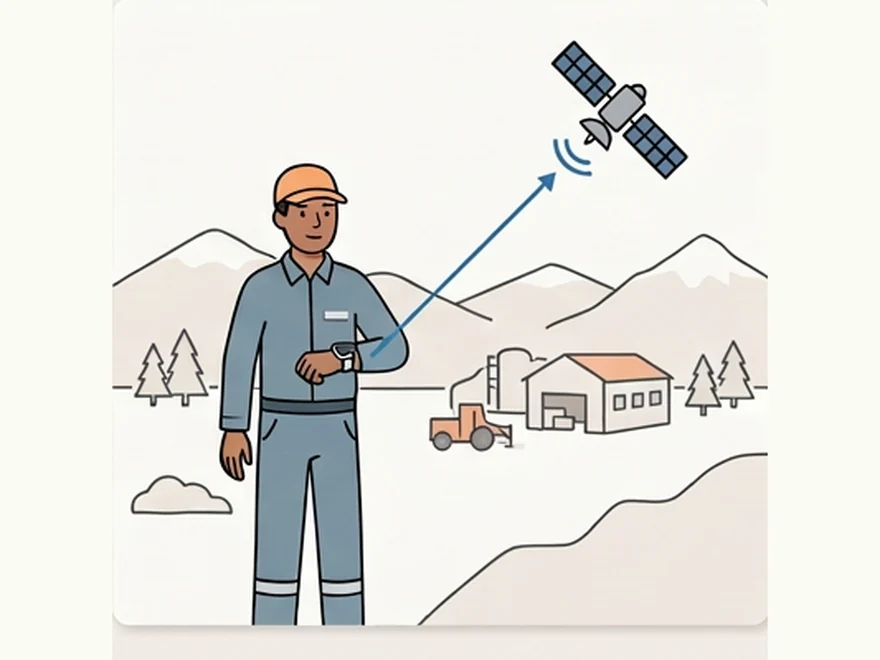
First, which situation is this?
A hobby — hiking, sailing, backcountry skiing — where a consumer device is often enough. Or a job, where an employer has a legal duty of care and a consumer phone feature usually isn't sufficient to discharge it. The devices overlap; the obligations don't.
"Satellite SOS" means two different things
The short version: some devices let you have a conversation with a rescue coordinator. Others let you press a button and hope. Both are marketed as satellite SOS, and the difference matters most at exactly the moment it counts.
Two-way messaging versus a one-way relay
Dedicated satellite communicators — Garmin inReach and similar, running on the Iridium network — support two-way messaging. You can tell a coordination center what happened, how many people are involved, whether anyone is injured, and whether you can wait until morning. They can reply, confirm help is coming, and give instructions. Garmin's coordination service passed its 5,000th rescue in 2020.
Phone-based satellite SOS — Apple's and Google's — connects to a relay center which then contacts local emergency services. It is genuinely useful and it has saved lives. But the conversational back-and-forth isn't there in the same way, and rescuers arrive with less information about what they're coming to.
Two practical differences beyond the messaging:
- Sky window. Phone-based systems need you to hold the handset toward a satellite and keep it there. A dedicated communicator clipped to a pack or harness keeps trying on its own, with more redundancy through brief gaps in the sky.
- Daily check-ins. Dedicated devices support routine messaging and tracking so someone knows you're fine. Phone SOS is for emergencies only — there's no "still walking, all good" signal.
Pricing is moving quickly. Apple and Google offer satellite SOS at no cost on compatible devices in roughly twenty countries, and Garmin has responded by making inReach emergency SOS free, with paid tiers reported from around $7.99 to $49.99 per month for ongoing messaging and tracking. Check current terms before buying — this is the fastest-changing area on this page.
If this is work, the bar is different
The short version: there is no single OSHA standard for lone workers, which is often misread as "no requirement." The General Duty Clause fills that gap, and a worker with no way to summon help is a recognized hazard with a feasible correction.
What actually applies, and what it means for device choice
OSHA has no standalone federal standard covering lone workers generally. What applies instead:
- General Duty Clause, Section 5(a)(1) — employers must provide a workplace free from recognized hazards likely to cause death or serious physical harm. A lone worker with no means of summoning help is precisely that, and the correction is feasible, which is what makes it citable.
- 29 CFR 1915.84 — working alone, in shipyard employment.
- 29 CFR 1910.146 — permit-required confined spaces.
- 29 CFR 1910.134 — respiratory protection.
- State plans may add requirements beyond the federal floor.
The practical expectation on employers is documented hazard assessment, a reliable means of communication, scheduled check-ins, and written emergency protocols. That's a system, not a gadget — which is where consumer devices fall short. A watch that alerts a family member doesn't produce an audit trail, doesn't escalate on a defined timetable, and doesn't record that a missed check-in was noticed and acted on.
If you're buying for a team rather than yourself, the question isn't "does this have SOS." It's "does this produce evidence that we monitored, escalated and responded." Occupational lone-worker services are built around that; consumer wearables aren't.
Man-down detection has the same weakness as fall detection
The short version: it triggers on impact, tilt or lack of motion — and so does bending over a machine, sitting still in a vehicle, or setting the device down. Expect false alarms, and check what happens when one fires.
How it works, and how to configure it so people don't switch it off
Man-down systems typically watch for three things: a sudden impact, the device staying tilted past a threshold, or an absence of movement for a set period. Any of those can happen in ordinary work.
Two features separate systems people keep using from systems they disable:
- A pre-alarm with a cancel window. The device warns the wearer first and gives them a few seconds to cancel before anyone is contacted. Without this, every false trigger becomes an incident.
- Adjustable thresholds and timers. A no-motion timer that suits a warehouse is wrong for a driver or a security guard on a static post.
And the question that decides whether any of it works: who receives the alert, and what are they required to do? A monitored service with defined escalation behaves differently from an app notification to a supervisor who may be in a meeting.
Coverage is the specification to check first
A cellular device is worthless where there's no cellular signal — and "nationwide coverage" maps are drawn optimistically. If the work or the route is genuinely remote, the honest options are satellite or nothing. Check the specific valleys, sites and roads involved, not the national map.
Eight questions before buying
- Is this for work? If so, does it produce an auditable record of monitoring and escalation?
- Two-way messaging, or a one-way relay to emergency services?
- Is there cellular coverage everywhere this will be used — genuinely?
- Who answers the alert, how fast, and what happens if there's no reply?
- Does man-down detection have a cancel window and adjustable thresholds?
- How long does the battery last in the field, and can it be charged there?
- What's the subscription, and what stops working if it lapses?
- Is there a scheduled check-in feature, or only emergency alerting?
What we're working on
Assessments for this segment will cover satellite performance under partial sky, man-down false-alarm behavior, escalation protocols, battery in cold conditions, certification status and published SAR figures. The weekly brief is where they land first.
No prevention claims, and not legal advice. No device prevents an accident, and none guarantees rescue. Satellite and cellular alerting can shorten the time before help arrives, which is a real benefit and a different claim. Nothing here is a determination of your obligations as an employer — consult a qualified safety professional or counsel on what applies to your operation.