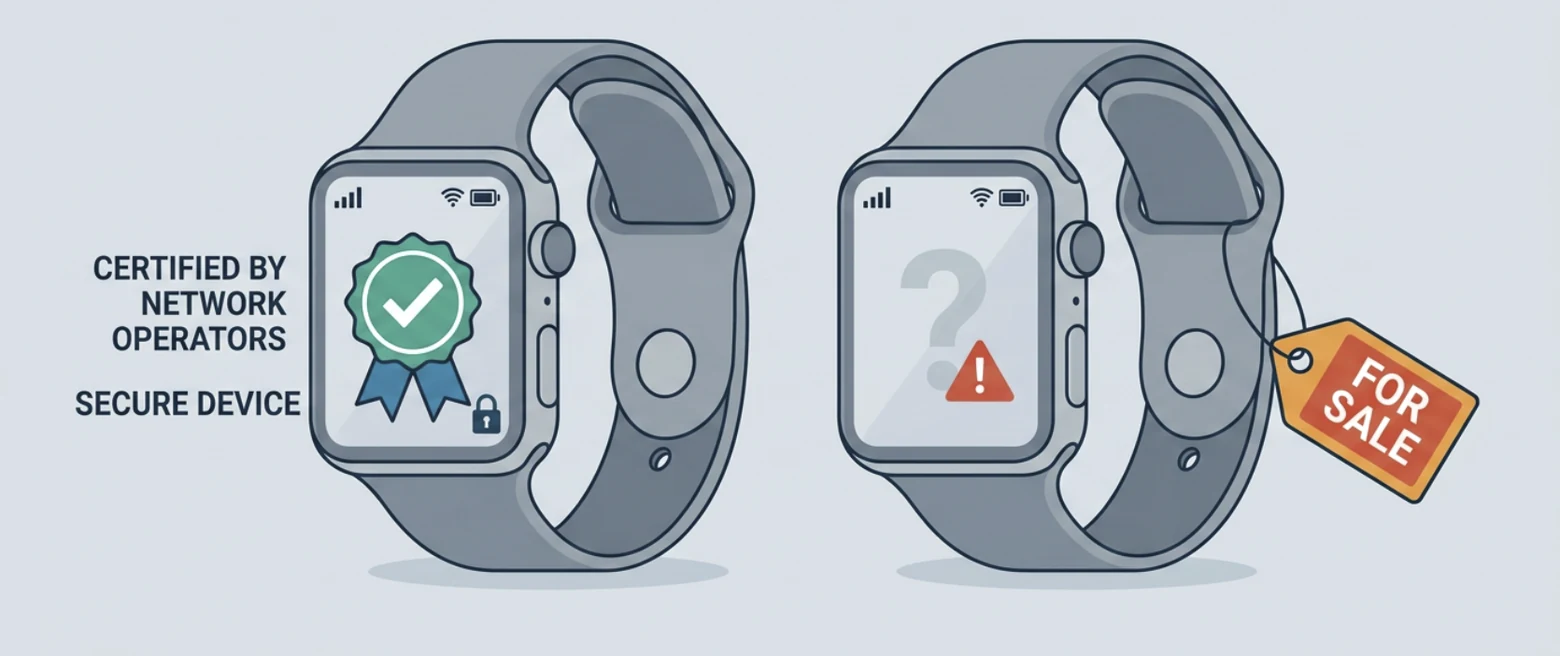
Two cellular wearables can look identical and sit in different worlds. One passed carrier certification and a network operator's own security review. The other cleared the legal minimum and shipped. Nothing on the box tells you which is which.
Three layers — and only the first is legally required.
The short version
Every wireless device legally sold in the US has FCC authorization — that's the floor, and it only concerns radio behavior. Devices sold through a mobile network operator clear two further layers: PTCRB certification and the carrier's own internal testing and security requirements. Devices bought on the open market usually clear neither, and there is no label that says so.
Three layers, not one
Layer
Who requires it
What it actually checks
Open-market device
Carrier-sold device
FCC equipment authorization
US law, for any RF device sold or imported
Radio emissions, interference, SAR. Nothing about data, privacy or app quality.
Required
Required
PTCRB
North American network operators
3GPP conformance, behavior under real radio conditions, correct frequencies, no unwanted transmission, secure SIM handling, carrier-specific requirements.
Often not held
Required
Operator's own certification
The individual carrier
Additional internal testing, plus the operator's own security, data-handling and regulatory obligations applied to the device and its platform.
Not applicable
Required before it reaches the shelf
What FCC authorization does and doesn't mean
What FCC authorization covers — and what it doesn't
An FCC ID on the back of a device is genuine and meaningful — it means the radio was tested and granted authorization, and it's where published SAR figures come from. It is also narrow. FCC authorization says nothing about whether the device connects reliably, whether your data is encrypted in transit, where that data is stored, how long it's kept, or whether the companion app is competently built.
A device can be fully FCC-authorized and still transmit a child's location over an unencrypted connection to a server in another jurisdiction. Those are separate questions, and only one of them is on the box.
What PTCRB adds
What PTCRB testing involves
PTCRB — the PCS Type Certification Review Board — is the certification program North American operators use for devices on their networks. Operators that belong to it require certification and may block devices that lack it.
Testing covers conformance to 3GPP standards, consistent performance under real-world radio conditions, transmitting on the correct frequencies without interfering with others or sending unwanted data, and secure SIM handling. In practice it's the difference between a device engineered for a network and a device that merely attaches to one.
It applies to cellular devices. A wearable that is Bluetooth-only, or Wi-Fi-only, has no cellular radio to certify — which is worth remembering, because a phone-tethered device sidesteps this layer entirely by not having the capability in the first place.
What the operator adds on top
PTCRB is an industry standard. A carrier selling a device under its own brand or in its own channel typically goes further: its own laboratory and field testing, its own acceptance criteria, and its own obligations around data retention, security and regulatory compliance applied to the device and the platform behind it.
That last part is the one families never see and it is the one that matters most for a child's or an older adult's device. A carrier operates under regulatory scrutiny, holds the relationship with the customer, and carries the reputational and legal consequences if the data is mishandled. An importer shipping through a marketplace holds none of those.
Laws are not certifications — and this is the part most people get backward
COPPA, CCPA and GDPR are frequently described as things a device "passes." They aren't. They're laws, and they apply according to who a company serves, not how the product is sold.
An overseas manufacturer selling a children's smartwatch to families in the United States is subject to COPPA. Selling through a marketplace instead of a carrier doesn't exempt anyone.
The real difference is enforcement, and it's threefold:
Nobody checks first. There's no gate between an overseas factory and a marketplace listing where someone verifies a privacy program exists. Carrier certification is exactly such a gate.
There may be nobody to enforce against. A regulator can act against a US carrier or a US brand. Acting against a company with no US presence, trading under a name that changes between product runs, is far harder.
The incentive isn't there. A carrier has a license, a reputation and a customer base at risk. A marketplace seller shipping a container of watches has considerably less to lose.
So the honest way to read it: the law protects your child either way. Whether anyone enforces that protection before something goes wrong depends heavily on who sold you the device.
How to check for yourself
Both of these are free, public, and take about a minute.
Find the FCC ID. It's printed on the device, under the strap, or in the settings menu. Look it up in the FCC's equipment authorization database. No result means it should not be on sale in the US.
Search the PTCRB device database at ptcrb.com for the brand and model. For a cellular wearable, absence is informative.
Ask the seller directly whether the device is PTCRB certified and which network it's approved for. A reputable brand answers immediately. Silence or confusion is itself an answer.
Check where the company is — look for a real US or EU business address and a named privacy contact, not just a support email.
What we do with this
ViaMondo is not a test laboratory and issues no certifications. What we do is look up what already exists: every cellular device we cover is checked against the public FCC and PTCRB databases, and we state which certifications it holds and which it doesn't — alongside whether it's sold through a carrier or on the open market. We don't treat open-market as automatically bad; plenty of established brands certify properly. We treat it as a fact buyers are entitled to know before they choose.
Official sources
Every acronym on this page belongs to a real body with a public website. If you want to check something yourself — or read the rule rather than our summary of it — go straight to the source.
Body
What it is
Official site
PTCRB
Cellular device certification for North America. Established 1997 by wireless operators; administered by CTIA Certification.
Global Certification Forum — the international equivalent of PTCRB, for devices built on 3GPP standards. Over 300 members. Publishes a wearables certification list.
Certification is not the same thing as a privacy law. PTCRB, GCF and FCC authorization say something about the radio. COPPA, CCPA and GDPR govern the data. A device can be fully certified and still handle a child's location badly, and the reverse is also possible.
Note. Certification status changes over time, and the same brand may sell certified and uncertified variants in different markets. Check the specific model you intend to buy rather than the brand.