The short version
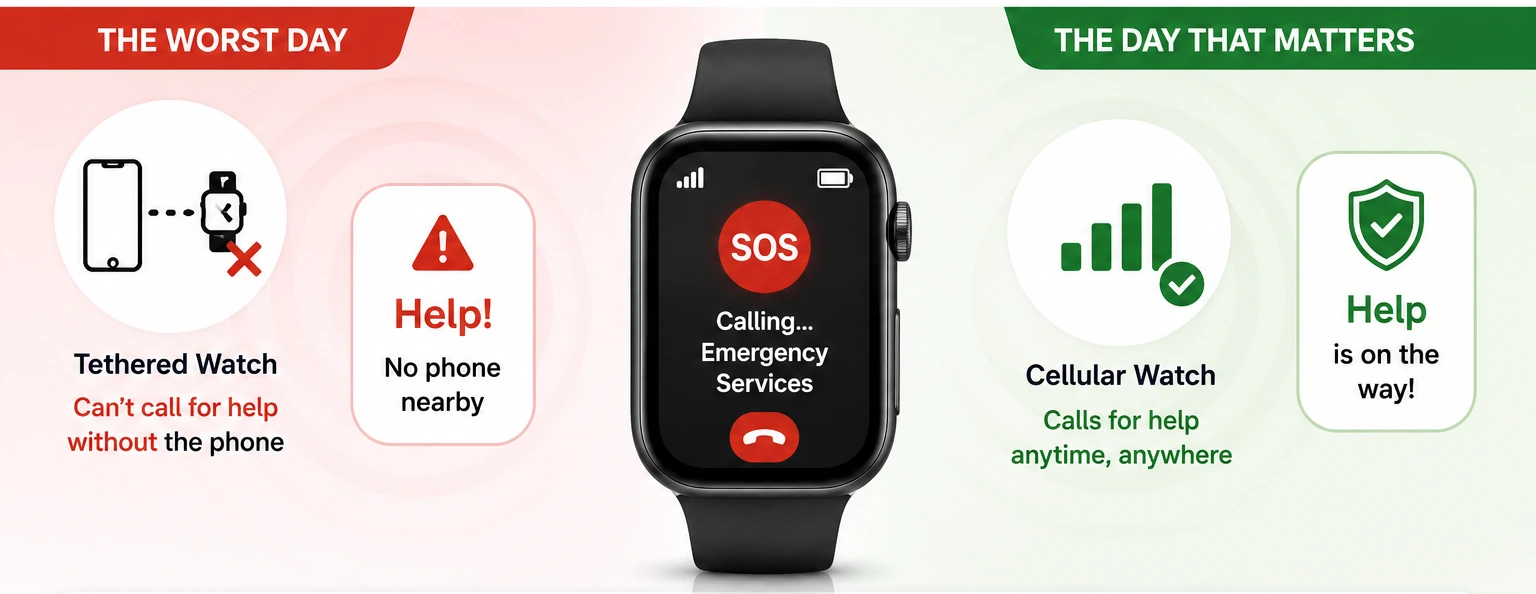
- A tethered watch borrows a phone’s connection. With no phone in range and no Wi-Fi it cannot call anyone — even though the fall was detected.
- A cellular watch has its own SIM and reaches the network alone. That’s what makes SOS, live location and incoming calls work away from the house.
- For an older adult living alone, or anyone with cognitive decline, cellular is the right default. For someone who genuinely always carries their phone, tethered is fine and cheaper.
- The catch is $10–15 a month and nightly charging. A watch that’s flat by four in the afternoon is worse than no watch, because the family stops checking in.
A woman in her late seventies goes out to the garden at four in the afternoon. Her phone is on the kitchen counter, where it lives. Forty feet away, she catches her foot on the edge of a paving stone and goes down hard.
She is wearing a smartwatch. Her daughter bought it for exactly this reason.
What happens next depends entirely on one specification, and it is not the one most families look at when they buy. It is not the fall detection. Nearly every watch in this category has fall detection now. It is whether the watch can reach a network by itself.
If it cannot, the fall is detected, the watch counts down, the watch tries to place a call — and nothing goes out. The phone is in the kitchen. The watch has no way to reach it and no way to reach anyone else. It will sit on her wrist showing an alert that only she can see, and she is the one person who cannot act on it.
This is the difference between a cellular watch and a Bluetooth-tethered one. On an ordinary day it is invisible. On the day it matters, it is the whole thing.
Three kinds of “connected”
The word gets used for all of them, which is how families end up buying the wrong one.
Bluetooth-tethered. The watch has no radio of its own beyond short-range Bluetooth. Everything — calls, texts, alerts, location upload — travels through a paired phone. Range is roughly thirty to a hundred feet indoors, less through walls. Out of range, the watch keeps counting steps and telling the time. It cannot contact anyone.
Tethered with Wi-Fi fallback. Same as above, but when the phone is out of Bluetooth range the watch can rejoin over a known Wi-Fi network — so it may still work at the far end of the house. Step outside that network and it goes quiet again. Wi-Fi ends at the property line, and most falls that matter happen at or beyond it.
Cellular. The watch has its own SIM — physical or eSIM — and its own number, on its own plan. It reaches the network with no phone involved at all. It works in the garden, at the shops, on the walking path, in the car park.
Apple documents this directly. To contact emergency services, Apple’s support page states, the watch or a nearby iPhone needs a cellular connection or Wi-Fi calling. A GPS-only watch with no phone in range and no Wi-Fi has no path out.
That is not a criticism of Apple — it is physics, and it is true of every tethered watch from every manufacturer. Apple is simply one of the few that writes it down plainly.
The four things only a cellular watch can do
Strip away the marketing and there are four capabilities that appear and disappear with that SIM.
It can call for help from anywhere. Fall detection, an SOS button, an automatic emergency call — all of these end in the same step, which is placing a call. The detection is the easy part. The call is the part that needs a network.
It can report location continuously, including outside. For a family managing a parent with dementia, this is the feature that matters most. A geofence alert — she has left the block — is only useful if the watch can send it at the moment she leaves.
A tethered watch stops reporting the instant she walks past the front gate without her phone, which is precisely the scenario the geofence exists for. See our dementia page for how this plays out in practice.
It can receive a call. This runs one way that families underestimate. Not just the parent calling out in an emergency, but the daughter calling in because her mother has not answered the landline for two hours, and the watch ringing on her wrist in the garden, and her being able to answer it and say she is fine.
A tethered watch cannot be reached when it is not near its phone. A cellular watch is a phone number that lives on the wrist.
It works when the phone has been left behind, lost, or has died. Which — for the population this article is about — is most days.
There is a fifth, for a narrower group. A small number of watches now carry satellite messaging for areas with no cellular coverage at all, which matters for hiking, rural properties, and long stretches of road. Apple’s Watch Ultra 3 has two-way satellite built into the watch itself rather than relayed through a phone.
It is a genuine capability and it is currently rare and expensive. Do not buy a watch for it unless you can name the specific place you need it.
What the health sensors actually do — and don’t
This is where we want to be more careful than most of the coverage you will find, because the gap between what people assume and what ships is wide.
Heart rate and irregular rhythm. Continuous optical heart rate is standard and reliable enough for trend data. Irregular rhythm notifications, which can flag possible atrial fibrillation, are FDA-cleared on several watches. They are a prompt to see a doctor, not a diagnosis.
ECG. Single-lead, FDA-cleared, useful — and it requires the wearer to hold a finger on the crown for thirty seconds. It is an active feature. It cannot help someone who is unconscious or confused.
Blood oxygen. Worth knowing the history here, because it complicates the autonomy argument this article is making. After a patent dispute with Masimo, Apple removed blood oxygen from US watches in early 2024, then restored a reworked version in 2025 in which the watch collects the data but a paired iPhone calculates and displays the result. In April 2026 the ITC declined to review further petitions, leaving that arrangement in place.
So on a US Apple Watch, this particular feature is less autonomous than the rest of the device — it needs the phone. It is a good illustration of why we check features per model and per region rather than trusting a spec sheet.
Blood pressure. No widely available smartwatch in the US gives you a cuff-equivalent blood pressure reading. Some newer models detect signs of chronic hypertension over a period of weeks and tell you to go check with a real cuff. That is a useful feature and it is not the same thing as measuring your blood pressure, and anyone selling it to you as the latter is overselling.
And the thing almost nobody mentions: most of these consumer health features notify the wearer. They do not, by default, notify a caregiver. A watch that detects an irregular rhythm at 3 a.m. shows a card to the sleeping person wearing it.
If you need a third party to be told, you need to check specifically whether the device or service does that, because most do not. Dedicated medical alert services with monitoring centers do. Consumer smartwatches largely do not. This is the single most common mistaken assumption we encounter.
The three costs nobody puts on the box
We would not be much use if we only made the case for cellular. Here is the other side, and the third item is the one that decides whether any of this works.
A monthly fee. A watch line typically runs $10–15 a month added to an existing carrier plan. Over three years that is $360–540 — frequently more than the watch cost. Budget for it as a subscription, not an accessory.
Battery life. Cellular radios and continuous location tracking are the two hungriest things a watch does, and safety use means running both. A watch rated for “up to 36 hours” in a review is describing light use. Configure it for frequent location updates on cellular and you are charging it every night without exception.
Dedicated medical alert pendants, which do far less, run for months. That contrast is not a knock on watches; it is the price of a device that also does everything else.
Charging discipline — the one that actually decides it. A watch that is dead at four in the afternoon every day is not neutral. It is worse than no watch, because the family believes it has coverage and has stopped checking in as often.
We would rather see an honest reckoning here than a sale: if the person will not reliably put it on a charger every night, or cannot, then a cellular watch is the wrong product and a simpler always-on device is the right one. Build the habit first. Attach charging to an existing nightly routine, and set up a low-battery alert that goes to the caregiver rather than only to the wearer.
Dementia is a harder case, and deserves a different rule
Everything above assumes the wearer can act — press a button, answer a call, confirm they are fine. For someone with cognitive decline, that assumption fails, and the analysis changes.
Sort the features into two piles. Active features need the wearer to do something: SOS buttons, ECG readings, answering calls, dismissing a fall alert. Passive features work whether or not the wearer participates: continuous location, geofence alerts, automatic fall detection with automatic escalation, worn-state detection.
For a cognitively intact senior, both piles are useful. For someone with dementia, only the passive pile can be relied on. Buy accordingly, and be skeptical of any product demo built around a button-press.
Two further cautions. People with dementia frequently remove watches — a device on the bedside table reports a location that is confidently, precisely wrong. And a watch is not supervision. It can tell you someone has left; it cannot stop them leaving, and the minutes between the alert and someone arriving are real minutes.
What we would ask before buying
- Does it have its own SIM, and what is the monthly plan cost? Get the number before you buy, not after.
- If the wearer never touches it, what still works? The honest answer to this question tells you more than any spec sheet.
- Who receives an alert — a family member’s phone, or a staffed monitoring center? And what happens if that person does not answer? Ask about the second and third contact in the chain.
- What is the real battery life with cellular on and location updating at the interval you actually need? Not the headline figure.
- What happens at the edge of coverage, and does anyone get told the device has gone offline?
- Is there a low-battery alert to the caregiver, not just to the wearer? This is missing more often than it should be, and it is the failure that undoes everything else.
Where we stand
For an older adult living alone, and for anyone with any degree of cognitive decline, we think a watch that cannot reach a network on its own is the wrong purchase. The entire value of the device rests on the worst day, and on the worst day the phone is on the kitchen counter.
For an active adult who genuinely carries their phone everywhere, a tethered watch is fine and cheaper, and we are not going to pretend otherwise. The case for cellular gets stronger the further the wearer gets from their phone — running, hiking, swimming, working outdoors, or simply being eighty and not in the habit of carrying one.
But the real decision is not cellular versus tethered. It is whether the device will be worn and charged. Get that wrong and the connectivity question never comes up, because the watch is in a drawer.
We will be testing devices in this category and publishing what we find — including battery life measured under realistic safety-use settings rather than quoted from a press release, and a plain answer, per device, to the question of who actually gets told when something happens.
Fall detection and emergency calling requirements confirmed against Apple’s published support documentation, checked 5 August 2026. Blood oxygen availability reflects the US position following the April 2026 ITC determination. ViaMondo has no affiliation with any manufacturer or carrier named here. Nothing in this article is medical advice; talk to a clinician about monitoring decisions for a specific person.
What readers have found
We can verify what a manufacturer publishes. We can’t verify what a device does on your wrist, in your house, on a bad day. That part only comes from you.
Loading reports…