The short version
- The brand on the box is often not the company holding your family’s data. Most trackers run on a platform someone else operates.
- Location is only the start. A kids’ watch commonly adds messages, contact lists, voice notes and photographs — on some models a camera and microphone.
- A shared platform layer means one failure can expose many brands at once.
- It’s knowable before you buy. The privacy policy usually names the operator, where data is stored and how long it’s kept — almost nobody reads that far.
You buy a tracker for your father. It has a brand name, a website, a support email, a five-star average across 3,000 reviews. From that day forward it records where he goes, when he leaves the house, how long he stays out, and the route he takes home.
The reasonable assumption is that the company on the box holds that information.
Often, it doesn't.
And it works in both directions
Most coverage of this frames it around elderly care. That's too narrow.
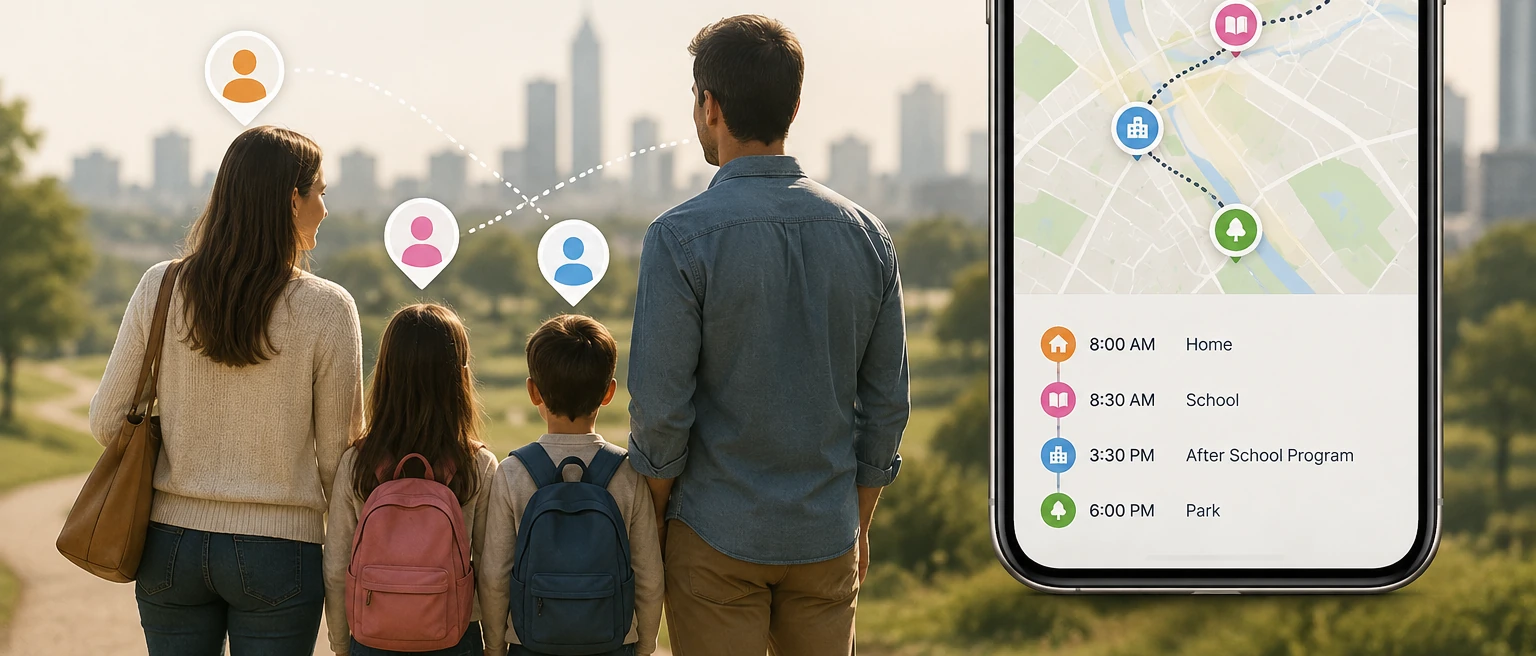
A children's smartwatch is a tracker with a screen on it. Same GPS chip, same cellular connection, same cloud platform, same companion app on a parent's phone. The packaging is brighter and there are games on it, but the data architecture underneath is the one described in this article.
If anything, the children's version collects more. A senior tracker typically records location and movement. A kids' smartwatch commonly adds messages, contact lists, voice notes, step counts, sometimes photographs — and on some models, a camera and microphone.
Two things make that a different kind of exposure:
- Duration. A child may wear one from six to twelve years old. That's a continuous, six-year record of where a specific minor goes, at what time, on which days — a far richer dataset than most adults ever generate.
- Consent. An adult choosing a medical alert makes a decision about their own data. A six-year-old cannot meaningfully agree to anything, and won't be able to review what was collected until long after it exists.
It's worth being clear that the research below reflects this. The Consumer Reports testing covered children's devices specifically. The Avast findings covered trackers sold for children, elderly relatives and pets alike — because they were, in several cases, the same hardware with different marketing.
The industry runs on other people's software
A large share of consumer GPS trackers are not designed, built or operated by the brand selling them. They are white-labeled: a platform built by one company, rebranded and resold by another.
The companies that build these platforms are open about it. Their sales pages describe exactly what's on offer — live tracking, route history, geofencing, alerts, reports, customer management, mobile apps — as a ready-made product you rebrand and sell as your own. One platform advertises compatibility with more than 900 different tracker models. A Shenzhen manufacturer states it has shipped over 20 million units and supplies resellers, white-label brands and OEM partners across more than 50 countries.
The plumbing is standardized too. Common protocols — GT06, Teltonika, Concox — let hardware from many different brands connect to the same backend. That's efficient engineering. It also means several trackers with different names, different packaging and different prices can be feeding the same servers.
There's a useful distinction in the trade: white-label means putting your branding on an existing product with minimal changes. OEM means deeper customisation — modified firmware, sometimes unique hardware. A white-labeled tracker may be, underneath, essentially identical to a dozen competitors.
None of this is inherently sinister. Small brands can't build global tracking infrastructure, and reusing a mature platform is often safer than a first attempt at building one.
What happens when the shared layer fails
The reason this matters became clear in research by security firm Avast, which examined GPS trackers marketed for children, elderly relatives and pets.
The researchers found serious flaws across 29 models produced by a single Chinese manufacturer, Shenzhen i365 — an estimated 600,000 devices, sold on Amazon and other major retailers at $25–50.
What they found:
- Devices shipped with the same default password — “123456” — across more than half a million units
- Data traveling from device to cloud was unencrypted, unauthenticated and in plain text
- That exposure allowed real-time GPS coordinates to be read by third parties
- Location data could be spoofed, feeding a false position to whoever was watching
- On models with cameras and microphones, flaws made it possible to use them to watch or listen
Twenty-nine models. One manufacturer. One set of flaws.
A parent buying for a child — or an adult child buying for a parent — who carefully researched the brand would have found nothing wrong. The problem lived a layer below the brand — in a component shared across every product built on it.
What the 2026 testing found
Consumer Reports evaluated 15 popular child-tracking devices in 2026 — smartwatches, Bluetooth trackers and GPS trackers — reviewing privacy policies, app permissions, default settings, and how each handles location, messages and device identifiers.
The results were mixed rather than damning, which is worth saying plainly.
Where products fell short
- Some lacked multi-factor authentication — meaning a single stolen password could expose a child's live location
- Some logged direct messages without encryption
- Several products — including AngelSense, Bark, Fitbit, Cosmo and Ticktalk — don't clearly indicate when microphones or cameras are active
Where the industry did better than its reputation
- Most privacy policies did clearly explain what data is collected and why
- Several apps let parents limit data-sharing or switch off targeted advertising
Products that scored well
The Tack GPS Tracker rated highest for data security among GPS trackers, while the BoT Talk GPS Tracker for Kids scored best for data privacy. Among smartwatches, the Apple Watch SE 3 (GPS + Cellular) scored high overall and the Garmin Bounce rated highest for data security.
Consumer Reports' own guidance: choose devices with strong privacy controls and multi-factor authentication, set privacy options to their most restrictive, and avoid trackers that depend on targeted advertising.
Five questions before you buy
You can't audit a company's server architecture from a product page. But you can ask questions that reveal how seriously a company takes this.
1. Does it offer multi-factor authentication?
If a single password protects live location of a child or a vulnerable adult, that's the whole security model. Consumer Reports found products without it.
2. Does the privacy policy state a retention period?
Not “we retain data as necessary” — an actual duration. Most don't. If it doesn't say, assume indefinitely.
3. Can you delete the data, and does deleting the account delete it?
These are different things. Ask both.
4. Who is named in the privacy policy?
Read to the end. If a company you've never heard of appears as a processor, sub-processor or service provider, that's your backend — and possibly your real data custodian. Also check which country's law applies.
5. How does this company make money?
Hardware plus subscription is a comprehensible business. Cheap hardware, no subscription, no clear revenue is a question you should want answered.
Where we stand
Nothing here says don't buy one. For a family caring for someone who wanders, a good device is genuinely valuable — over 60% of people living with dementia will wander at some point. For a parent whose child walks home from school, the reassurance is real too.
What it says is narrower, and worth holding onto: the brand you're buying from and the company holding your family's location history — your child's or your parent's — may not be the same organization. That relationship is knowable, it's usually documented in the privacy policy, and almost nobody reads that far.
We'll keep publishing what we find, brand by brand — including when the answer is that a company is doing this properly.
Get the next one
One email a week on wearables: what launched, what was recalled, and which company quietly changed its data policy.
Sources
- The Hacker News — Flaws in over half a million GPS trackers expose children's location data
- Infosecurity Magazine — Security flaws found in 600,000 GPS child trackers
- BankInfoSecurity — Track the trackers: GPS devices fail security tests
- Consumer Reports — Should you track your child with a GPS tracker or kids smartwatch?
- AZFamily — Child tracking devices collect more than location data
- BGR — Some kids' GPS trackers skip this key security feature
- OpenVTS — White label GPS tracking software
- SKYWONDER — White label GPS tracker solutions
- GPSWOX — White label GPS server
What readers have found
We can verify what a manufacturer publishes. We can’t verify what a device does on your wrist, in your house, on a bad day. That part only comes from you.
Loading reports…