The short version
- Apple now leases hardware — Apple Watch from $11.99 a month. At the end you hand it back; you don’t own it.
- The model looks made for children, who outgrow devices faster than anyone.
- It doesn’t work for kids’ watches, and the barrier is residual value. They’re too cheap, come back too battered, and there’s no resale market to recover the difference.
- A carrier could make it work — they already have the billing and trade-in machinery. But nobody has said what happens to two years of a child’s location history on a returned device.
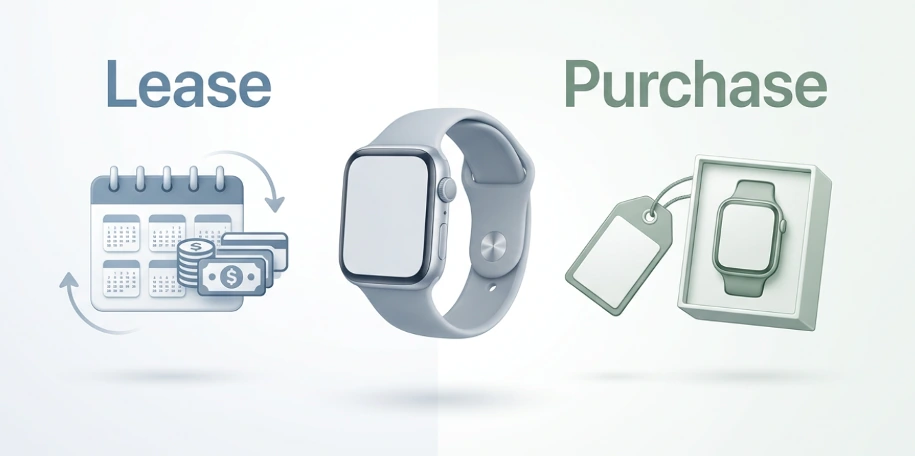
Apple started leasing hardware last week. On 28 July it launched Apple Upgrade, a leasing program run with Klarna: iPhone from $17.99 a month, Apple Watch from $11.99, on 12- or 24-month terms. At the end you return the device, buy it outright, or roll into a new lease.
It's a genuine shift. Apple has offered installment plans for years, but those were purchases spread over time — you owned the phone at the end. This isn't that. Apple's own terms are blunt about it:
"You will not own your device at the end of your lease, unless you pay the purchase fee."
Which raises an obvious question for anyone buying technology for a child. Kids outgrow devices faster than anyone. A watch bought for a seven-year-old is wrong for a ten-year-old — wrong size, wrong features, wrong social expectations. Leasing seems almost designed for that. Pay monthly, hand it back, step up to the next one, and eventually to a phone with parental controls.
So would it work?
Probably not — and the reason is more interesting than the idea.
The math that decides it
A lease is a bet on what the device is worth when it comes back. The lessor buys the hardware, rents it to you for a term, takes it back, and recovers the rest of its value by refurbishing and reselling. Your monthly payment covers the depreciation plus their margin. The higher the leftover value, the lower your payment can be.
Apple's published example makes the ratio visible:
| Device | Purchase price | 24-month lease | Total paid | You own |
|---|---|---|---|---|
| Apple Watch Series 11, 42mm | $399 | $11.99/mo | $287.76 | Nothing |
| iPhone 17 Pro 256GB | $1,099 | $31.99/mo | $767.76 | Nothing |
Both land near 70% of the purchase price. Apple can price it there because a two-year-old iPhone 17 Pro is still worth real money — there's a deep, liquid refurbished market, and Apple runs it themselves.
Now apply that to a children's smartwatch.
Cellular kids' watches sit an order of magnitude below that. Verizon lists the Gizmo Watch 3 at $4.16 a month over 36 months and the Gizmo Watch 3 Adventure at $2.77 — roughly $150 and $100 respectively. At Apple's 70% ratio, a $150 watch would lease for about $4.40 a month. That sounds appealing until you ask what the returned device is worth.
Almost nothing.
A two-year-old kids' watch has been dropped in a playground, swum in, chewed, scratched and outgrown. Apple runs both a certified refurbished store and Apple Trade In for its own watches; we could find no equivalent trade-in or refurbished program from any manufacturer or carrier selling children's smartwatches in the US. If one exists, we'd like to know about it. Until then the residual value that makes an iPhone lease work looks close to zero here.
And when residual value is zero, the lease payment has to cover essentially the whole device — plus financing, plus the cost of processing a return, plus the losses on units that come back broken or never come back at all.
Handling a returned $159 watch costs about as much as handling a returned $1,099 phone. Same shipping, same inspection, same data wipe, same customer-service call. On a $1,099 device that overhead is noise. On a $159 device it's the whole business case.
That's why leasing spread through cars, then phones, then laptops — expensive things that hold value — and stopped there. It isn't a fashion. It's arithmetic.
Except the model is already here, in disguise
Here's the thing worth noticing: most cellular kids' watches in the US are already sold on monthly terms. The Gizmo Watch on Verizon, the amiGO on AT&T, SyncUP KIDS on T-Mobile — parents pay a device charge alongside a line fee, typically over 24 or 36 months.
The difference is what happens at the end. Carrier device payment plans are installment purchases: pay them off and the watch is yours. Apple Upgrade is a true lease: pay it off and you hand it back.
So the industry already solved the affordability problem the lease is supposed to solve. What it hasn't solved is the upgrade problem — the reason a parent might want a lease in the first place.
And that's the version that could work. Not a standalone lease, but a carrier-bundled upgrade path: a watch at seven, a bigger watch at ten, a locked-down phone at twelve, all on one line, one bill, one account, with the old device going back each time.
The carriers are the only players positioned to do it. They already own the billing relationship, already run device trade-in, already absorb credit risk, and already have the parent under contract. A device maker attempting this alone would be building a financing operation to move $159 units. The carriers have one already.
What nobody is asking about
There's a question underneath all of this that the wearable industry hasn't confronted, and it's the one this site exists to ask.
A leased device gets returned. What happens to the child's data on it?
A kids' smartwatch is not a laptop. It holds location history — where that child went, at what time, every day, for two years. It holds voice messages between a child and their parents. On some models, photos. Contact lists. In the case of watches with AI assistants, a log of what a child asked.
Apple's lease terms run to several hundred words on damage fees, early termination charges and return condition. They say nothing about data on a returned device. That's not unusual — no consumer lease does — but it's a gap that matters far more for a child's device than for an adult's laptop.
Concretely, before anyone leases a device to a family:
- Who wipes it, and to what standard? Factory reset on the watch, or verified erasure of the cloud account behind it?
- What happens to the location history held on the platform? The device may be wiped; the back end usually isn't. That data typically lives with the platform operator, who is often not the company on the box.
- Is the child's account closed or transferred? If a watch is refurbished and passed to another family, what carries over?
- Who is liable if it isn't done properly? The lessor, the manufacturer, or the platform company none of them named?
These are answerable questions. They simply haven't been asked, because leasing hasn't reached this category yet.
If it does, they need answering first. A returned children's device carrying two years of a child's movements is a materially different object from a returned MacBook, and it should be governed by different terms.
And a trap worth reading in the fine print
One detail in Apple's terms deserves attention from anyone who thinks leasing is simpler than buying:
"If you do not upgrade, terminate your lease, or purchase your device by the end of the initial lease term, the lease will convert to a month-to-month lease for up to six months. Your monthly payments may increase during the month-to-month periods. If you take no action at the end of your extension period, you will be charged the purchase fee under your lease."
Read that again. Doing nothing is not a neutral option. Doing nothing means higher payments for six months, then an automatic charge for the full purchase price.
For a tech-attentive adult managing one device, that's manageable. For a parent juggling three children's devices across different renewal dates, "I'll deal with it later" is the normal state of affairs — and it's the state that costs the most.
Any lease aimed at families would need that default reversed: automatic return reminders, no auto-purchase, no payment escalation for inaction. Otherwise you're building a product whose worst outcome is triggered by ordinary parental busyness.
Where this lands
Standalone leasing for kids' smartwatches doesn't work, and the barrier is residual value, not consumer appetite. The devices are too cheap, they come back in too poor a condition, and there's no resale market to recover the difference.
Carrier-bundled upgrade paths could work, because carriers already carry the billing relationship, the credit risk and the trade-in machinery. It's a small step from what they do now.
But the data question has to be settled first. A returned device with two years of a child's location history on it, and no stated erasure standard, is not a detail to sort out later. It's the thing to sort out before the first one ships.
We'll keep watching. If a carrier does launch a kids' device lease, the first thing we'll ask for is the erasure policy — and we'll publish the answer, or the silence.
Sources: Apple Newsroom — Apple Upgrade launches in the United States, 28 July 2026, including the full lease terms and pricing examples. Children's watch pricing from Verizon's own product pages, checked 4 August 2026.
What readers have found
We can verify what a manufacturer publishes. We can’t verify what a device does on your wrist, in your house, on a bad day. That part only comes from you.
Loading reports…